

You plan to perform a Tech DD? We are happy to share insights from our data-driven approach and strong experienced CTOs.
By Florian Pahl, CTO and founder · >100 buy- and sell-side assessments · LinkedIn
The buyer's Tech DD usually starts after first-round bids, when a price is already on paper. A few weeks later, a report lands with the investment committee. Each finding in it carries a cost: a price adjustment, an escrow, a specific indemnity or an exclusion from the Warranty and Indemnity (W&I).
Sellers rarely see that report before it is used in the negotiation, and its hardest questions are now about AI: can the product capture the upside of AI, and does its position hold when AI makes features cheap to copy? Vendor Tech DD, the technology part of a vendor due diligence and also called sell-side Tech DD, changes the order. The seller assesses the technology first, fixes what can be fixed, and decides how the rest is presented. This article covers what to assess, how to triage the findings, what belongs in the data room and when to start.
Key takeaways
- Tech findings the buyer discovers late become price chips, escrows or W&I exclusions, because insurers treat them as known risks.
- A seller-side assessment across tech, team, product and scalability, with AI running through all four, surfaces the same issues months earlier, when fixing them is cheaper.
- AI is part of every Tech DD today. Buyers test whether the target can use AI and whether its market position survives it, and weak answers reach the valuation multiple.
- Every finding belongs in one of four tiers: fix before launch, quick win, in progress with an owner, or opportunity for the buyer.
- A complete, consistent data room shortens the buyer's review and leaves less room to renegotiate.
How does Vendor Tech DD increase exit value?
Vendor Tech DD increases exit value by moving discovery to the seller. Issues the buyer finds late turn into price reductions, escrows or W&I exclusions. Found early, most of them can be fixed, built into the plan or disclosed with a credible remedy, which removes them as negotiation leverage.
The insurance mechanics explain why late findings are so expensive. W&I insurance covers unknown risks only. A matter the buyer knew or should have known about before signing is excluded, and that exclusion explicitly extends to findings from the buyer's due diligence. Each tech finding therefore returns to the seller as a specific indemnity, a retention or a lower price.
In exclusivity, the buyer's advisers put the number on each issue, usually at the conservative end. Law firm Foot Anstey notes that giving all bidders the same information from the start reduces the need for price chips later in the process.
The stakes are highest on AI. Doubts about AI readiness or defensibility put the growth case in question, so they reach the valuation multiple itself.
What should a seller assess first?
Start with AI, because it runs through all four areas a buyer's Tech DD covers: technology, team, product and scalability. Then turn to the issues that can reprice or stop a deal, such as key-person risk, security and licence compliance. Cosmetic improvements can wait.
We put AI first in every assessment and look at it from two sides. AI readiness asks whether the product can capture the upside: accessible data with clear usage rights, an architecture that can host AI features, and a team that has shipped AI to production. AI defensibility asks whether the position holds when features, interfaces and rules-based workflows become cheap to copy. Weak answers on either can reprice a deal or end it.
None of these is rare. Black Duck’s 2026 OSSRA report, based on audits of 947 commercial codebases between November 2024 and October 2025, covering 197 M&A transactions, found licence conflicts in 68% (up from 56% a year earlier), high-risk open source vulnerabilities in 78% and components more than four years out of date in 92%. A buyer running the same scans will find the same issues. Our article on Tech DD red flags covers the wider list.
How should sellers triage the findings?
Sort every finding into one of four tiers using two questions: does it threaten the deal, and can it be resolved before launch? Fix the critical items, close the quick wins in a short pre-sale sprint, show ownership of structural issues and frame the rest as opportunities for the buyer. Material items still go in the disclosure letter.
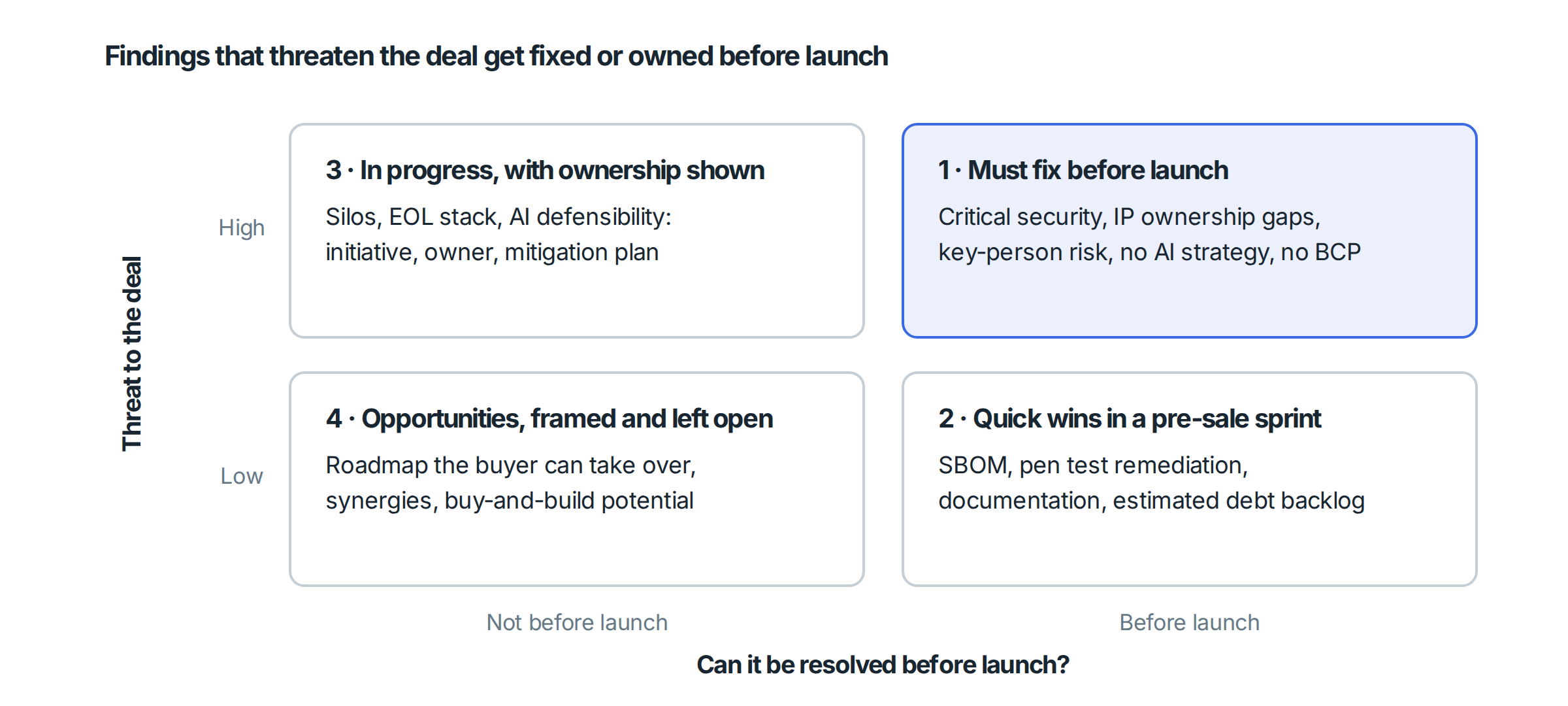
- Must fix before launch. Critical security issues, gaps in IP ownership (code, contractor IP assignments, licences), unmitigated key-person risk, AI features built on data without clear usage rights, no consistent AI strategy, and missing business continuity plans. These are the findings that stop deals or trigger specific indemnities.
- Quick wins in a pre-sale sprint. An SBOM (Software Bill of Materials), an AI system inventory, pen test remediation, documentation, and a tech debt backlog that is prioritised and estimated. Each takes weeks, and each removes an easy question from the buyer's list.
- In progress, with ownership shown. Structural issues such as knowledge silos or an end-of-life stack, and strategic topics such as the product roadmap and AI defensibility. Define the initiative, assign resources and attach a mitigation plan, so the buyer sees management in control.
- Opportunities, framed and left open. Outline a roadmap the buyer can take over and point to synergies with their portfolio or buy-and-build plans. Disclosed with a credible plan and cost, a finding becomes part of the buyer's value-creation case.
Avoid starting a large rewrite in the run-up to an exit. A half-finished migration adds risk the buyer has to price, and it ties up the engineers who should be answering DD questions. Whatever the tier, disclose material issues in the disclosure letter: matters disclosed at signing generally fall outside later warranty claims.
What belongs in the tech section of the data room?
Buyers ask for the same core artefacts in almost every Tech DD. Having them ready, current and consistent shortens the process and leaves less room for price discussions. Figure 2 gives a starting set from what we request on the buy side: three examples for each of the four areas. A full request list is longer.
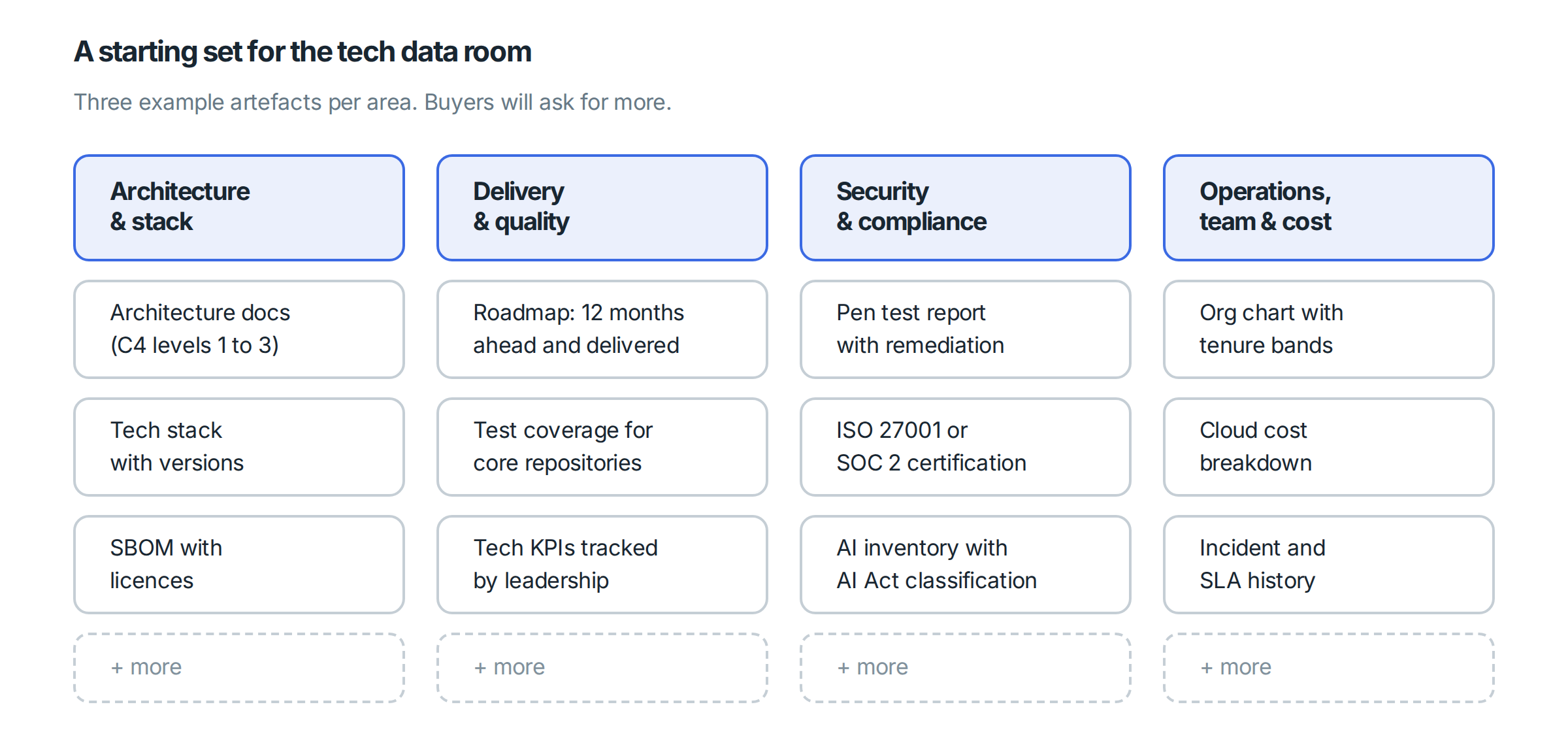
Consistency matters as much as completeness. Buyers compare every artefact with what management says in the presentation, and a roadmap that contradicts the pitch costs more credibility than a missing document. The same applies to the org chart: it should show clear ownership and match how the teams actually work.
When should a seller start?
Start as early as the exit plan allows. Twelve to eighteen months leaves time to fix structural issues. Three months still allows a clean data room and well-prepared disclosure. The later the start, the more findings move from the "fixed" tier to the "framed" tier.
How does Vendor Tech DD support the equity story?
Vendor Tech DD turns technology into evidence for the equity story. The seller presents each finding with its context: why a decision was made, what it cost and what is planned. Bidders start from the same verified facts, so the confirmatory phase has less to uncover. Where the report is issued with reliance, the buyer and their lenders can scope their own review around the gaps.
From the field. A B2B SaaS company had grown through several acquisitions. Each deal had added a product, and the portfolio had become hard to explain: overlapping offerings, no clear USP and no consistent AI strategy. A buyer would have read this as integration risk and priced it in.
TechMiners ran the Vendor Tech DD and then worked with management on the response. Before launch, the company set a long-term strategy with AI at its core and brought the acquired brands under one integrated market presence. Teams were restructured around the target product, each with clear ownership. Together we defined the roadmap for the technical transition to a single platform, and the first migration steps were under way when the process started.
The vendor material set out the business case for bidders: maintenance costs reduced by up to 50% once the transition is complete, a shorter time to market for new features, and a unique market position. The fragmented portfolio went from a likely price discussion to part of the equity story: a transition under way, with owners and a plan, and the savings framed as upside for the buyer.
Our analysts have built, scaled and sold technology companies, and on the buy side we see which findings move a price. TechMiners guides targets through the preparation, from the first assessment to the buyer's Q&A, with CTO sparring for management. At signing, the tech section of the SPA (Share Purchase Agreement) is shorter, the escrow smaller and most questions have been answered once already.
Sources and figures
- Gaps in W&I insurance coverage, Iida Vainio, NORDIA Law, via Mondaq, 11 September 2026
- The rise of vendor due diligence in private equity, Foot Anstey, January 2025
- Black Duck, 2026 Open Source Security and Risk Analysis, March 2026. Sample: 947 codebases from Black Duck audits (M&A, compliance and internal risk reviews), not a random market sample.
Talk to a TechMiners expert
Get a no-obligation assessment of your deal.