


You plan to perfom a Tech DD? We are happy to share insighs from our data-driven approach and strong experienced CTOs.
While every startup now claims an "AI-first" strategy, our assessments reveal that 95% of enterprise AI pilots fail to deliver measurable ROI (source). This guide classifies AI ventures into four distinct categories and identifies five critical patterns, from production-grade MLOps to human-in-the-loop oversight, that separate scalable platforms from fragile wrappers.
The post-ChatGPT investment landscape is crowded with companies claiming to be AI-driven. For investors, the challenge is no longer finding AI opportunities, but validating if the "AI" is a defensible asset or just clever marketing. At TechMiners, having assessed hundreds of targets, we have observed that the way a venture handles AI affects every area of Tech Due Diligence: tech, product, team, and scalability.
Here, we focus on companies that we classify as AI Enhancers or AI Pioneers, as previously defined.
5 things tech due diligence reveals about AI companies
1. The data moat is the only true moat
Code is easy to replicate, especially now that coding agents reduce the time required to do so by an order of magnitude (or 2, or 3). Writing clever prompts for ChatGPT, Gemini, or Claude can be complicated when talking about nuances, but it’s barely enough to set a company apart from competitors. Defensibility comes from the data pipeline. Clean, pipelined data is an exclusive asset, whereas raw data is merely a cost. Proprietary, first-party data, sometimes accumulated over years, creates an unbridgeable gap in model performance.
2. MLOps: the engine room of scalability
Without Machine Learning Operations (MLOps), AI remains a black box that is hard to impossible to audit or scale. A professional framework ensures the model survives the real world through:
- Data engineering & versioning: automated pipelines that clean and version data. This ensures traceability, allowing teams to identify exactly which data influenced a model’s behavior.
- Model validation & testing: Model behaviour is validated through structured, repeatable testing against defined performance, safety, and bias criteria. This supports ongoing improvement in quality, reliability, and behavioural consistency over time.
- Monitoring: Real-time detection of performance degradation (drift) or unethical outputs (bias) before they cause reputational damage.
3. Agentic AI requires an "Assembly Line" with guardrails
The shift toward Agentic AI (where specialized agents work together) brings efficiency but introduces new risks. A professional setup uses an "Assembly Line of Experts" coordinated by an Orchestrator. Crucially, this must include Guardrail Agents and QA Agents whose sole job is to review the output of other agents for security and accuracy. Fallback scenarios to engage a human-in-the-loop (HITL) are crucial.
4. Watch for the "Danger-Combo" in protocols
The industry is shifting toward standards like the Model Context Protocol (MCP), which unifies how AI agents talk to third-party systems like Slack or CRMs. While MCP accelerates delivery, investors must watch for a dangerous overlap, as beautifully illustrated by Korny Sietsma on Martin Fowler’s blog, and addressed by other AI heavyweights like Simon Willison:
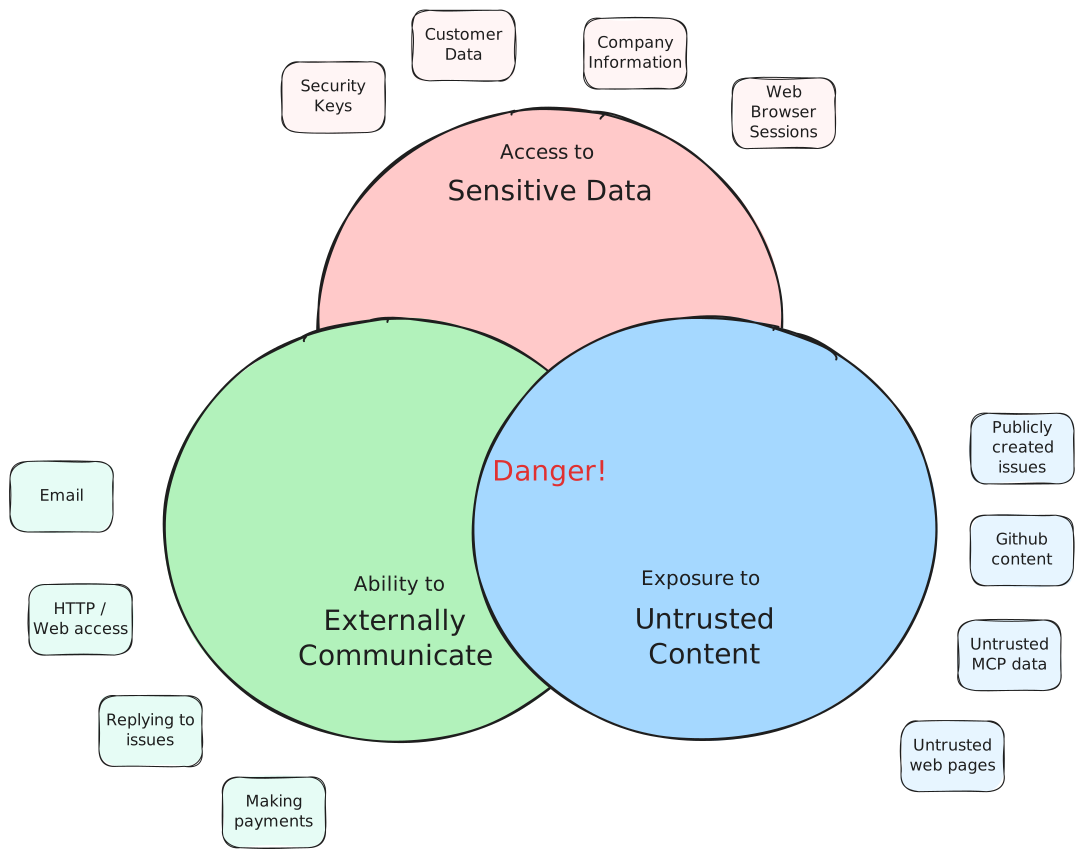
Danger emerges when an AI system simultaneously has access to sensitive data, the ability to act externally (e.g., make payments), and exposure to untrusted inputs. Without explicit action boundaries and human-in-the-loop gates, this is a major security risk.
5. Engineering discipline in AI-centric products
Companies building "AI as a core product" often carry the highest tech debt. The primary driver is early development led by scientists or academic teams who deliver strong AI capabilities but lack experience in production-grade software engineering.
As a result, core systems frequently miss essential engineering disciplines: clear architecture, testing, security boundaries, and operational resilience. Additionally, time to market pressure on AI capabilities pushes teams towards short-term delivery at the expense of long-term maintainability.
Strong teams take an augmented engineering approach: Experienced engineers remain responsible for architecture, reliability, and system integrity. Companies that combine advanced AI with disciplined software engineering scale far more effectively than those built without sufficient engineering maturity.
AI due diligence checklist for investors
Are you looking for a more detailed checklist to deep dive into AI Due Diligence?
Sharpen your investment team's ability to spot technical red flags in AI ventures? Contact the TechMiners team today to discuss our specialized workshop, "Tech DD in the Age of AI," designed specifically for VC and PE investors.
Key takeaways
- MLOps is mandatory: Don't invest in AI that isn't backed by a structured lifecycle. Clear processes, monitoring, and evaluation are all required to guarantee long-term quality.
- Trust, but verify: Agentic systems require automated guardrail agents and human-in-the-loop oversight for code changes.
- Engineering discipline matters: AI capability alone does not scale. Look for teams where experienced engineers own system design and reliability, with AI integrated into a disciplined software engineering practice.
- Security is paramount: Be wary of systems where AI has autonomous access to sensitive data and external action capabilities without strong safety mechanisms and processes to maintain security and protect data.
Talk to a TechMiners expert
Get a no-obligation assessment of your deal.



%20(1).png)